We host founder dinners every other Thursday in Vancouver, San Francisco and Los Angeles. The goal has always been the same: put the right people at the same table and get out of the way. What happens next is up to them.
This post isn't a highlight reel. The scenarios below are illustrations, not stories about specific members. They describe the five kinds of connection the format is designed to make possible, and why a table of five makes each one more likely than a crowded room does.
The advisor
Picture a pre-seed SaaS founder eight months in. She has product, early users, and a pitch deck refined through a pile of cold email rejections. What she doesn't have is anyone in her corner who has actually done it before.
Now seat her next to an operator who has already scaled and sold a company. He isn't looking to advise anyone. He came for the conversation. But two hours is long enough for him to understand her problem properly, and if it interests him, offering to look at her deck is a small step.
That's the connection a big event almost never produces. Advice from someone who has been there needs context, and context takes more than ninety seconds by the bar.
The co-founder
Imagine a technical founder who can write the code, architect the system and ship fast, but who knows growth isn't his thing. And imagine a growth marketer who is tired of doing it for companies she doesn't own.
Across a dinner table, two people like that can discover they're describing the same problem from opposite sides of it. You can read more about why some Vancouver neighborhoods keep producing these conversations in our Gastown founders guide.
The thing about meeting a potential co-founder at a dinner versus on a co-founder matching platform: you see how someone thinks in conversation before you've committed to anything. You know if you like them as a person. That matters more than a resume.
Peer support
Building a company comes with a particular kind of exhaustion that doesn't show up on a dashboard. Plenty of founders reach a point where they wonder whether shutting it down would be a relief, and most of them don't say it out loud.
A small table with a no-pitching rule is one of the few places where saying it feels safe. Other founders have been through the same stretch, and hearing that from peers who lived it lands differently than any platitude. The table's in-app chat means those conversations don't have to end when the bill comes.
The warm investor intro
Two founders at a dinner in Kitsilano could easily realize mid-conversation that they both know the same Vancouver VC. One of them has a real relationship. The other has been trying to get a meeting for weeks through cold email and LinkedIn.
This is the part that doesn't happen at conferences or open networking events. When you've spent two hours at a dinner with someone, making an introduction on their behalf is easy. You're not doing a favor for a stranger. You're vouching for someone you actually know something about now. That's the difference between a warm intro and a real warm intro.
The first customer
Think of a founder building a tool for e-commerce brands, running Zoom demos for strangers and finding that converting a cold demo into a paying customer is a long, slow road.
Seat that founder next to someone who runs a DTC brand, and the conversation can turn to operations without anyone pitching. The person across the table isn't evaluating a product. They're talking to someone they've spent an evening with. That's a very different starting point for a sales relationship, and it only works because nobody at the table is allowed to sell.
Why the format makes these more likely
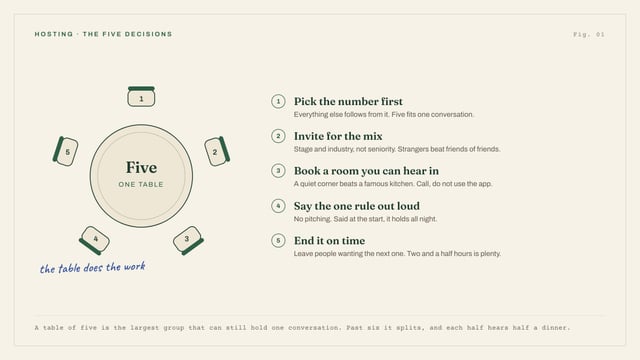
These connections become possible because the table is small. Five people. Enough to have a real group conversation, not so many that anyone disappears into the crowd. They become possible because a person reads every application and every seat at every table is there for a reason. And they become possible because there's no agenda. No pitching, no panels, no business cards. Just founders talking honestly about what they're building and what they need.
If you want to read more about why the format works, we wrote about it in why founder dinners work. The short version: small groups, shared meals, and curation beat volume.
If you're a founder in Vancouver, San Francisco or Los Angeles and you're ready to find out who's at your table, apply for a seat. Dinners run every other Thursday at 7pm.