Picture a founder three months after closing a Series A, sitting in a parking lot unable to go back into the office. On paper, winning. In their body, cooked.
That picture is not rare. In a 2015 study led by Dr. Michael Freeman at UC San Francisco, 72% of entrepreneurs surveyed reported mental health concerns. There's no reason to think Canadian founders are spared. Founder burnout Canada is not a soft topic anymore. It's operational risk. Burned-out founders miss board updates, ship worse product, and torch co-founder relationships that took years to build.
This post is about what actually works. Not affirmations. The recovery paths available to Canadian founders, what they cost, and what to expect.
The warning signs Canadian founders keep missing
Burnout rarely arrives quietly. The signs are usually loud; founders just don't listen. Here's what to watch for.
Sleep goes first. You're up at 3am rewriting the pitch deck for the fourteenth time. Then appetite. You stop cooking, you're eating gas station protein bars between calls. Then comes the physical stuff: back pain, jaw clenching, chest tightness that can send a perfectly healthy 31-year-old to the ER at 2am convinced it's a heart attack.
The subtler signs matter more. You stop returning texts from friends. You feel resentment when your co-founder takes a weekend off. You start fantasizing about a competitor acquiring you just so it ends. You feel relief, not worry, when a key hire quits. If that last one sounds familiar, it's time to call your doctor.
The Canadian founder community talks about hustle culture less than Americans do, but the isolation runs deeper because our ecosystem is smaller. If you're running a Series A company in Halifax, there might be four other people in your city who understand your day. That loneliness compounds burnout fast, which is why we wrote about founder loneliness in Canadian startups as its own problem.
Therapy in Canada: what founders actually pay
Here's the practical breakdown most founders never get.
Provincial healthcare covers psychiatry (with a referral) but not psychology. A psychiatrist can prescribe and diagnose, but wait times in Ontario and BC run 6 to 14 months for non-urgent cases. That's not useful when you're spiraling in September and have a board meeting in October.
Private therapy in Canada runs $180 to $250 per session in Vancouver and Toronto, $140 to $200 in Kelowna, Calgary, and smaller markets. A common rhythm is weekly for the first two months, then bi-weekly. Budget $6,000 to $10,000 for a year of consistent care.
Options founders actually use:
- Inkblot Therapy: Canadian platform, $100 to $135/session, video-based, book within 48 hours.
- Felix Health: prescription and mental health, useful if you need SSRIs but can't get a family doctor.
- Maple: same-day virtual psychiatry, covered partially in Ontario and BC.
- EAP programs: if you're VC-backed, your health benefits likely include 6 to 12 free sessions. Most founders don't know this. Check your plan.
If your company has a formal health spending account, therapy may be covered through it as a business expense. Ask your accountant before you assume either way. If you're between accountants, our post on founder-friendly banks in Canada has referrals to firms that handle this well.
The sabbatical playbook
Founder sabbaticals in Canada tend to be short: think 3 to 6 weeks, not 3 months. Cash runway is tight, and many boards are unfamiliar with the concept.
The structure that works:
Week 1: You will not relax. You'll check Slack 40 times, panic about deals, and feel guilty. This is normal.
Weeks 2-3: Nervous system starts to settle. You sleep 9 hours a night. You cry at random things. Also normal.
Weeks 4+: Actual thinking returns. This is when the strategic clarity you went looking for starts to show up.
Two rules make it work. First, hand off in writing before you leave: an operating doc for whoever is covering, listing every decision they can make without you. The more complete it is, the less the company needs you while you're gone. Second, tell your board early. Frame it as "I'm doing this to be effective for the next five years, not the next five weeks." Good investors, including the kind we covered in our piece on Canadian founders and US investors, tend to be supportive when you're direct.
Co-founder dynamics: the split most people don't see coming
Burnout rarely happens to one co-founder at a time. It ripples. The person who didn't burn out often resents the one who did. The one who burned out feels guilty and less-than. Six months later, someone's leaving.
The fix is to renegotiate the relationship out loud. Not the cap table. The daily operating one.
Concrete moves co-founders can make:
- Split the week on customer calls, so each founder gets guaranteed days off the phone.
- Replace a daily standup with a short weekly sync and a shared written doc, and win back hours of context-switching.
- Bring in a fractional COO to take operational load off both founders. It costs less than losing a co-founder.
The worst outcome is pushing through: a founder grinds through burnout to close the next round, then leaves soon after. The company may survive. The friendship often doesn't.
Canadian-specific resources founders actually use
Skip the generic lists. Here are the Canadian options worth knowing about.
9-8-8 Suicide Crisis Helpline: call or text 9-8-8, anywhere in Canada, any time. For crisis moments, not ongoing care.
Hope for Wellness Help Line: for Indigenous peoples across Canada, with counsellors available in English, French, Cree, Ojibway, and Inuktitut.
BC's Bounce Back: free CBT-based program, referral through GP.
Ontario Structured Psychotherapy Program (OSP): free CBT if you qualify, waitlist is 2 to 4 months.
Beyond formal resources, community is the underrated one. Every Canadian startup scene, from the BC startup ecosystem to Toronto's, has informal founder circles if you go looking, and in smaller scenes like the Okanagan one good dinner can put you in the room with most of the operators at your stage.
Coming back stronger: what recovered founders do differently
Founders who recover and rebuild don't just add meditation. They restructure the job.
Common patterns:
- Calendar audit: cut a big share of recurring meetings within 30 days of returning. Weekly investor updates can become monthly written ones; most investors prefer that anyway.
- One hard boundary: no work between 7pm Friday and 9am Monday. Not aspirational. Enforced. Phones in a drawer.
- Therapy stays: not "when things get bad again." Weekly, indefinitely. Same as going to the gym.
- A peer group of 3 to 5: not a mastermind, not a Slack community with 800 people. Five founders you can text at 11pm.
- Physical baseline: usually strength training 3x/week, 7 hours of sleep as a hard floor, cardio for anxiety management.
None of this is groundbreaking. What's different is that recovered founders stop treating these as nice-to-haves. They're operating requirements, same as raising a round or hiring a CTO. On the hiring point, if you're rebuilding your team post-burnout, our guide to the first 10 hires at a Canadian startup covers how to structure a team that doesn't require you to be the bottleneck.
Common questions
How do I know if it's burnout or depression? Burnout usually lifts with rest. Depression doesn't. If two weeks off the job doesn't move the needle at all, talk to a doctor about screening. Both can be true at once.
Can I take a sabbatical if we're pre-revenue? Yes, but shorter. 2 weeks with a co-founder covering, or 1 week fully offline if you're solo. The alternative is a longer forced break when you crash.
Will investors punish me for talking about burnout? The good ones won't. The bad ones will. That's useful information about who's on your cap table. Most Canadian VCs in 2026 have watched enough founders burn out that they'd rather you name it early.
What about medication? Common and helpful for a lot of founders. SSRIs, ADHD meds, and sleep support are all conversations to have with a psychiatrist or GP. Nothing weak about it. A lot of the highest-performing founders you know are on something.
You don't have to figure this out alone
The founders who recover fastest are the ones with a small circle of peers who've been through it. Not advisors. Not mentors. Peers at your stage who can say "yeah, I did that too, here's what worked."
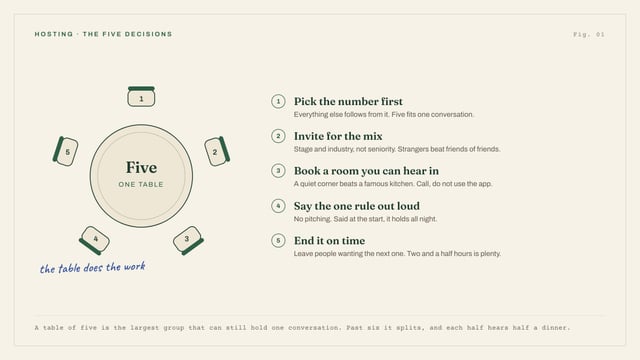
That's the whole reason Founder Feast exists. Five founders, one table, every other Thursday at 7pm in Vancouver, San Francisco and Los Angeles. No pitching. Just the kind of conversation that reminds you other people are doing this too, and most of them are also barely holding it together. If that sounds useful, apply for a seat.